
“How can EDDY Pump move slurry containing up to 70% solids by weight?” It is one of the most common questions we hear—and it is a fair one. Most people have seen what happens when sand, sludge, rocks, grit, ash, tailings, or drilling mud enter a pump designed mainly for water. The flow drops. The pump plugs. Wear accelerates. Production stops.
The answer is not simply more horsepower, a larger motor, or more suction. It starts with the way an EDDY Pump is designed and how that design changes the path the slurry takes through the pump.

The recessed rotor creates a strong, synchronized flow at the inlet, while the open volute and wide internal clearances give dense slurry, abrasive particles, and oversized solids room to pass. The rotor geometry behind that flow is patented, but what matters most to the customer is the result: the pump was designed around moving solids rather than treating them as something the pump must tolerate.
That is an important distinction. Other pumps may be described as high-solids, non-clog, vortex, or recessed-impeller pumps. EDDY Pump uses its own rotor geometry and synchronized inlet-flow pattern to bring the material into motion and move it through an open internal path.
That same pump-platform strategy scales from the 1-inch HD-1000 through the 16-inch HD-16000, allowing the internal flow path, solids passage, flow capacity, operating speed, and required driver power to scale with the application.
|
Quick Answer |
What Does “70% Solids by Weight” Actually Mean?
This is the first point that needs to be clear: 70% solids by weight is not the same as saying 70% of the space inside the pipe is filled with solid objects.
If 100 pounds of slurry contains 70% solids by weight, then approximately:
- 70 pounds of the mixture are solid material.
- 30 pounds of the mixture are liquid.
The solids may occupy less than 70% of the physical volume because sand, rock, minerals, ash, and other materials are usually heavier than water. That is why every specification, proposal, and sales conversation should clearly state whether the percentage is measured by weight or by volume.
The accurate claim is: EDDY Pump is designed to handle slurry containing up to 70% solids by weight, depending on the material, pump model, system design, and operating conditions.
The Simplest Way to Understand the Difference
Think about drinking water through a narrow straw. It works easily. Now imagine trying to pull a thick milkshake—with chunks of chocolate chips or fruit—through that same straw. The problem is not only that the milkshake is thicker. The narrow opening gives the material very little room to move.
Many conventional pumps face a similar problem. Their internal parts operate close together, which is useful for moving cleaner liquids but can create choke points when the fluid contains a high concentration of solids.
EDDY Pump is closer to using a much wider passage, with a strong swirling motion helping pull the mixture through. The slurry still has to be pumpable, and the system still has to be sized correctly, but the material is not being forced through the same tight internal restrictions.
What Makes the EDDY Pump Design Different?
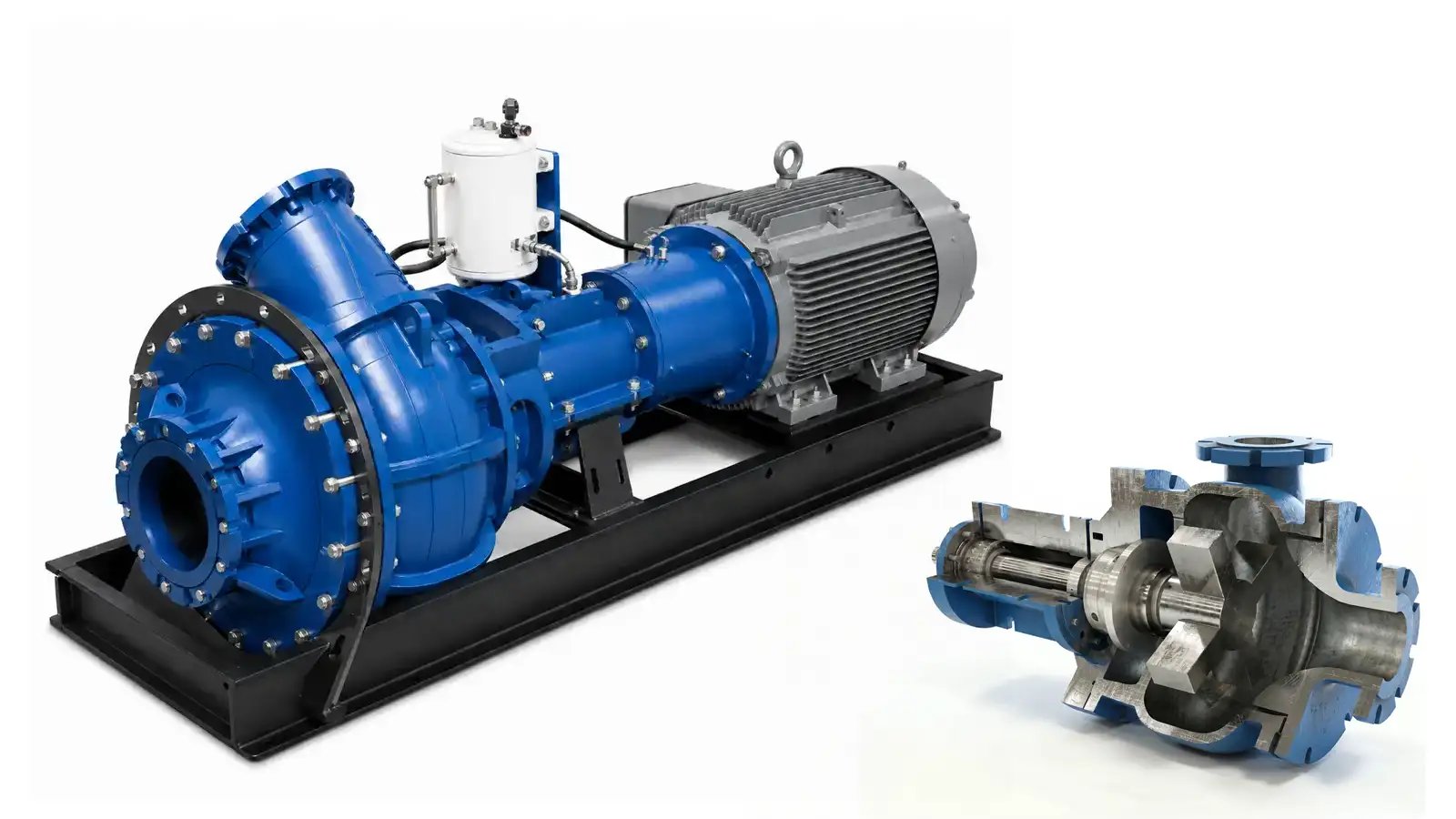
Many pumps are described as high-solids, non-clog, vortex, or recessed-impeller pumps. Those are broad product categories. The EDDY Pump difference is the way its recessed rotor, open volute, and synchronized eddy flow work together as one solids-handling system.
The rotor is designed to form a synchronized column of flow toward the inlet. At the same time, a lower-pressure reverse flow helps draw the surrounding slurry toward the pump and then toward the discharge. In plain language, the pump creates a controlled, tornado-like movement at the inlet instead of relying only on an impeller to catch and throw the material.
That distinction matters because the flow action works together with the recessed rotor and open internal path. The flow pattern helps bring dense material into the pump. The open geometry gives solids room to pass. The correctly sized driver and pipeline then keep the slurry moving through the complete system.
The rotor geometry is patented, but the customer benefit is simpler: EDDY Pump has a distinct internal design built to move difficult solids, and the complete system is engineered around the material being pumped.
Why Many Conventional Pumps Struggle as Solids Increase
A pump that performs well with clean water can behave very differently when the fluid becomes heavier, thicker, and more abrasive. As solids concentration increases, several problems can appear:
- Narrow internal passages become more likely to plug.
- Larger particles can become trapped between rotating and stationary parts.
- Abrasive solids can quickly wear close internal clearances.
- The slurry requires more power to move.
- Particles settle in the suction line or discharge pipeline when velocity is too low.
- The pump may move more water than useful solids, forcing the operation to dilute the material.
This does not mean every centrifugal or positive displacement pump is wrong for slurry. It means the pump has to be designed for the specific material and duty. A pump selected from a clean-water curve or a discharge size alone can still be a poor match for a high-solids application.
How the EDDY Pump Design Moves High-Solids Slurry
1. The Rotor Is Recessed from the Main Flow Path
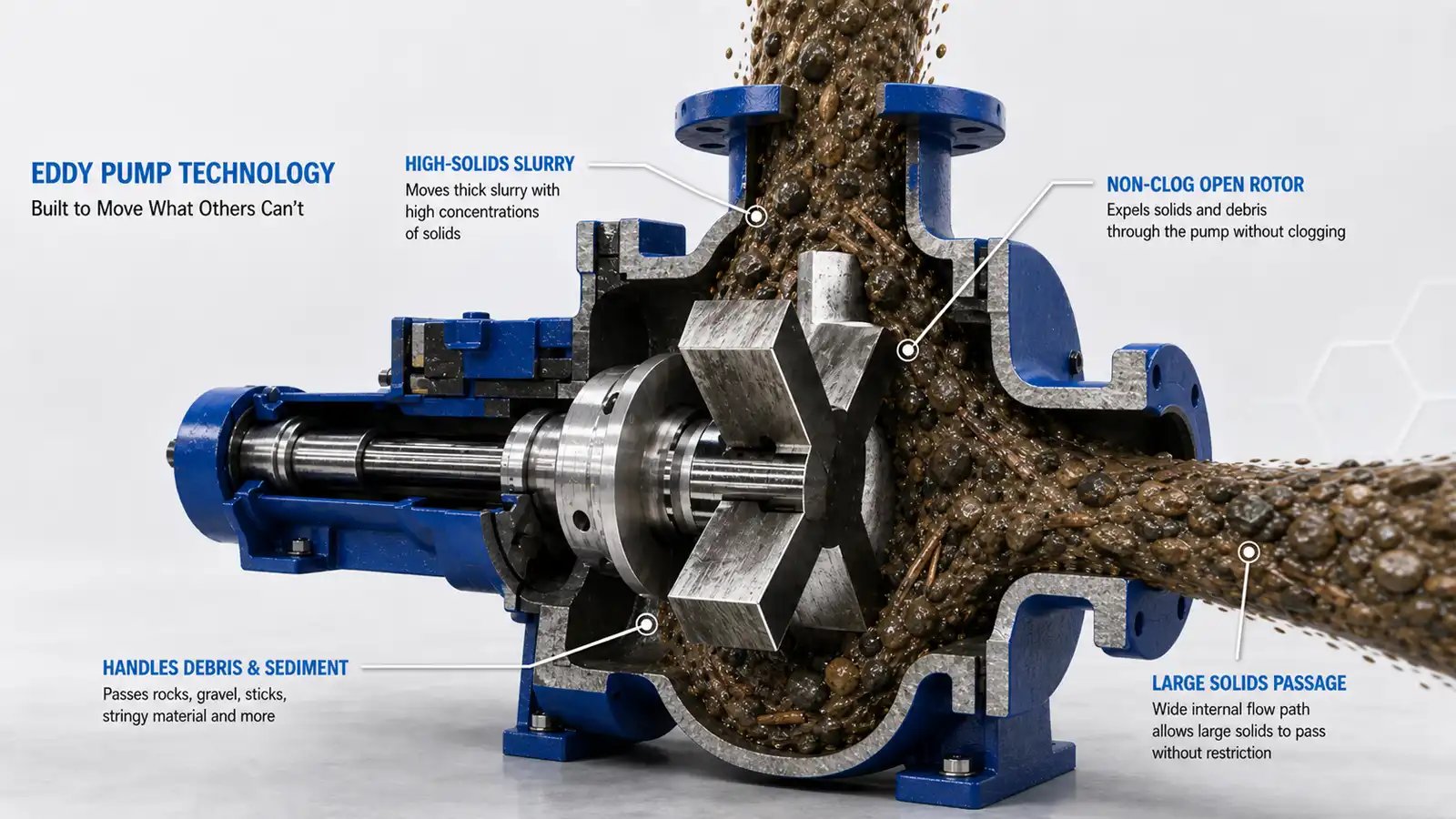
The EDDY Pump rotor sits farther back inside the pump housing than the impeller in many conventional pumps. The slurry is not forced directly through a set of narrow impeller passages.
Keeping the rotor recessed from the primary material path also reduces—but does not eliminate—direct impact between the rotating component and abrasive solids. That matters when pumping sand, gravel, tailings, ash, grit, or other materials that can quickly damage exposed wear surfaces.
2. The Open Volute Creates a Wide Path for Material
The open volute and large internal clearances give solids more room to move through the pump. Across the full EDDY Pump slurry pump family, the platform scales from the 1-inch HD-1000—rated for 1 to 200 GPM and solids up to 0.75 inch—to the 16-inch HD-16000 platform, rated for 10,000 to 13,000 GPM and solids up to 15 inches. The published platform range is commonly specified for 40% to 70% solids by weight, but the actual operating concentration depends on the material and the complete pumping system.
3. The Rotor Creates a Synchronized Eddy Flow
As the rotor turns, its geometry creates a strong, synchronized column of flow—similar to a controlled underwater tornado. This flow extends toward the inlet, helping draw surrounding slurry and solids into the pump. A reverse eddy flow then carries the material toward the discharge.
The important point is that this is not simply open space inside a pump. The flow pattern and open internal geometry work together. The rotor helps bring material into motion, the open volute gives the solids room to pass, and the complete system keeps the liquid and solids moving together.
4. Wear Materials Are Selected for the Application
Open geometry alone is not enough. Abrasive and corrosive slurry can still damage the wrong material. EDDY Pump offers wear-component options such as high-chrome, stainless steel, and duplex stainless steel on selected models. The final metallurgy should be based on abrasion, pH, salinity, chemical exposure, particle hardness, and expected service life.
5. The Motor or Driver Supplies the Required Power
The pump design creates the pathway for the solids. The motor, diesel engine, hydraulic motor, or hydraulic power unit provides the muscle needed to keep that material moving.
As slurry becomes denser, heavier, more viscous, or harder to push through the pipeline, the drive must provide enough torque and horsepower to maintain the required pump speed, flow, and head. An undersized driver can slow the pump, increase motor load or hydraulic temperature, reduce pipeline velocity, and allow solids to settle.
However, adding a larger motor does not create the 70% solids capability by itself. A larger driver cannot correct a restricted internal pump path, poor material feeding, an undersized discharge line, excessive total dynamic head, or slurry that will not flow. The pump, driver, intake, pipeline, and duty point must be selected as one system.
The clearest way to explain it is: the EDDY Pump rotor and open-volute design create the pathway for high-solids slurry; the correctly sized motor or driver supplies the power needed to achieve the project’s flow, head, production, and discharge-distance requirements.
How Does an EDDY Pump Affect the Pump Curve?
A pump curve shows how much flow a specific pump can produce against different amounts of head at a stated operating speed. The shape of that curve comes from the pump model, rotor geometry, and speed. In that sense, the EDDY Pump design defines the pump’s baseline hydraulic curve.
The published curve is a starting point—not the complete answer for a slurry project. EDDY Pump model curves are generally based on clean-water testing. Once sand, sludge, tailings, ash, or another solid material is added, the slurry may be heavier, more viscous, and more difficult to move. The pipeline also has to overcome elevation, friction, bends, valves, and the velocity required to keep particles from settling.
Those conditions can move the actual operating point away from the clean-water expectation. The pump may deliver less flow or head, require more power, or operate at a different efficiency than it would with water. EDDY Pump’s open flow path helps the pump continue moving solids without the same clogging restrictions found in many conventional designs, but it does not remove the hydraulic effects of slurry density, viscosity, or pipeline resistance.
The operating point is where the pump curve meets the system curve. That is why EDDY Pump reviews the material and the full discharge system together. A custom pump curve or project-specific selection can account for solids concentration, specific gravity, particle size, viscosity, pipe diameter, discharge distance, elevation, fittings, and pump speed.
One motor point is especially important: putting a larger motor on the same pump at the same RPM does not automatically move the pump curve or create more flow and head. The larger motor gives the pump enough power and torque to operate at the required duty point without overloading. Changing the pump speed—such as with an approved variable-frequency drive or hydraulic-speed adjustment—does change the pump curve, and it also changes the power required.
The simple way to say it is: the pump design establishes the curve, the slurry and pipeline determine where the system operates on that curve, and the driver provides the power needed to hold that operating point.
For a project-specific review, request a custom pump curve based on the actual slurry and pipeline.
How the EDDY Pump Platform Scales from 1 Inch to 16 Inches
EDDY Pump uses the same basic high-solids design principle across a broad platform range, but a 1-inch pump and a 16-inch pump are very different systems. As the pump grows, the flow range, solids passage, production capacity, required power, pipeline size, and installation requirements also grow.
The table below shows how the platform scales. Driver ranges are examples of available electric or packaged power options from the current product-family specification deck. Final motor, engine, hydraulic motor, or HPU selection must be confirmed against the slurry and duty point.
|
Pump Platform |
Flow Range (GPM) |
Solids Handling |
% Solids by Weight |
Example Driver Range |
|---|---|---|---|---|
|
1–200 |
Up to 0.75 in |
40–70%* |
2.5–5 HP |
|
|
50–390 |
Up to 1.75 in |
40–70%* |
5–20 HP |
|
|
100–780 |
Up to 2 in |
40–70%* |
20–40 HP |
|
|
250–1,200 |
Up to 3 in |
40–70%* |
30–125 HP |
|
|
400–1,800 |
Up to 4 in |
40–70%* |
Application-specific |
|
|
450–2,500 |
Up to 5 in |
40–70%* |
75–250 HP |
|
|
1,400–3,600 |
Up to 7 in |
40–70%* |
250–500 HP |
|
|
1,600–5,000 |
Up to 9 in |
40–70%* |
250–500 HP |
|
|
2,600–7,300 |
Up to 11 in |
40–70%* |
500–1,000 HP |
|
|
10,000–13,000 |
Up to 15 in |
40–70%* |
1,000–2,000 HP |
*Application dependent. The maximum solids concentration is not guaranteed for every material or duty. Driver power ranges vary by electric, submersible, self-priming, diesel, hydraulic, and custom package.
The 2-inch High Head HH-2000 is a separate high-head platform. View the 2-inch High Head slurry pump.
What Does High-Solids Pumping Change for the Customer?
The goal is not to reach 70% simply because it is a larger number. The goal is to move the useful material at the concentration that gives the project the best production, reliability, and downstream result.

|
Potential Benefit |
Why It Matters |
|---|---|
|
Move more solids per gallon pumped |
A denser slurry may allow the operation to transport more actual material instead of mostly water. |
|
Reduce dilution water |
Some projects can avoid adding as much water simply to make the material pumpable. |
|
Reduce downstream water handling |
Less added water may reduce settling, dewatering, treatment, storage, or disposal requirements. |
|
Reduce clog-related interruptions |
A wider internal path can allow debris and larger particles to pass instead of stopping production. |
|
Simplify material handling |
Hydraulic transport may replace or reduce repeated excavation, trucking, conveyors, or manual transfer in the right application. |
Important: higher solids concentration is not automatically better. If the slurry becomes too thick to flow, cannot be fed consistently, settles in the pipeline, or requires more power than the system can provide, production can decrease. The correct operating concentration is the one the complete system can move reliably.
Real-World Examples of High-Solids Pumping
Mining and Tailings
Mine tailings can combine fine mineral particles, sand, clay, chemicals, and larger debris. In mining and tailings applications, the ability to move a denser slurry can reduce unnecessary water transport and help clean pits, ponds, sumps, and process areas. The pump still has to be selected for the slurry's specific gravity, particle distribution, pH, flow target, and discharge distance.
Dredging and Sediment Removal
In dredging and marine construction, the material may include sand, silt, shells, gravel, organics, and man-made debris. Pumping at a higher solids concentration can mean moving more sediment and less water, but the dredge head, cutterhead, jetting, pump intake, pipeline velocity, and disposal method must work together.
Wastewater and Industrial Sludge
Wastewater sludge can contain grit, rags, fibrous material, settled solids, and changing moisture content. Wastewater and sewage pumping applications often require a non-clog design because the material is rarely consistent. A pump that can tolerate changing solids and debris may reduce the need for repeated shutdowns and manual clearing.
Fly Ash and Bottom Ash
Ash slurries are abrasive and can settle quickly. In fly ash pumping applications, moving a denser mixture can reduce the water volume sent to ponds, treatment, or dewatering equipment. Wear materials, agitation, pipeline velocity, and seal selection remain critical.
Drilling Mud and Cuttings
Drilling mud and cuttings can be viscous, heavy, and inconsistent. Oil and gas pumping applications may involve transferring thick mud and solids that are difficult for water-oriented pumps. The pump must be matched to viscosity, cuttings size, chemical compatibility, and the required pressure.
High-Viscosity Process Material
Some applications are not dredging projects at all. EDDY Pump process pumps are used where dense, abrasive, viscous, or high-specific-gravity material must move through a plant or process line. Examples can include mineral slurry, lime, industrial waste, sludge, and other difficult fluids.
For additional examples, explore the EDDY Pump case study library and the red mud and bauxite pumping case study covering a highly viscous, abrasive, and corrosive material.
Can Every EDDY Pump Automatically Pump at 70% Solids?
Depends on conditions—and this is an important part of explaining the claim honestly. “Up to 70% solids by weight” describes the design capability of selected EDDY Pump platforms under suitable conditions. It is not a guarantee that every material, pump size, pipeline, or jobsite will operate continuously at exactly 70%.
Two slurries can have the same solids percentage and behave completely differently. Fine clay may become sticky and resistant to flow. Coarse sand may settle rapidly. Angular rock may create impact wear. Fibrous material may wrap around external equipment. A heavy mineral slurry can place a much greater load on the pump than a lighter organic sludge.
The Factors That Determine Actual Solids Capacity
|
Project Variable |
Why It Changes Performance |
|---|---|
|
Solids specific gravity |
Heavier particles increase slurry density, power demand, and settling force. |
|
Percent solids by weight or volume |
The measurement basis changes how the concentration should be interpreted and calculated. |
|
Particle size and shape |
Large, angular, or irregular particles affect passage size, wear, and pipeline behavior. |
|
Particle-size distribution |
A mixture of fines and coarse solids can pack or settle differently than uniform material. |
|
Viscosity and rheology |
Sticky, thixotropic, or non-Newtonian material may require special testing and additional power. |
|
Pump model and operating speed |
Each model has a pump curve at a stated speed. Changing speed changes the curve; installing a larger motor at the same speed does not create more flow or head by itself. |
|
Available horsepower or hydraulic power |
The driver must have enough power and torque for the slurry and duty point. More horsepower provides capacity to hold the operating point, but it does not replace proper pump and pipeline sizing. |
|
Total dynamic head |
Elevation, pipeline friction, fittings, valves, and slurry corrections determine the resistance the pump must overcome. |
|
Pipeline diameter and velocity |
The pipe must maintain enough velocity to prevent settling without creating excessive friction and wear. |
|
Material feed and agitation |
The pump cannot move solids that are not consistently entering the intake or remaining suspended. |
|
Temperature, pH, and chemistry |
These conditions affect materials of construction, seals, coatings, and component life. |
Which EDDY Pump Configuration Fits the Job?
The pump technology can be deployed in several ways. The correct configuration depends on where the material is located, how the system will be operated, and what access is available.
|
Configuration |
Best Starting Point |
Learn More |
|---|---|---|
|
Submersible slurry pump |
Material is in a sump, pit, pond, tank, basin, or dredge area and the pump can operate directly in the slurry. |
|
|
Self-priming pump |
The pump must remain on the surface, needs portable access, or must recover prime during intermittent operation. |
|
|
Process or flooded-suction pump |
The pump is part of a fixed plant, tank discharge, continuous transfer, or process loop. |
|
|
Dredging equipment |
The project requires excavation, agitation, positioning, remote operation, or systematic removal of settled material. |
How to Move from a 70% Solids Claim to the Right Pump Selection
A high-solids rating should start a technical conversation—not end one. The fastest way to determine whether the pump will work is to provide the information that controls the duty point.
Before requesting a pump recommendation, gather:
- The material being pumped and where it comes from.
- Percent solids, clearly identified as by weight or by volume.
- Solids specific gravity and slurry density.
- Maximum particle size and expected debris.
- Viscosity or a material sample when the slurry is unusually thick.
- Target flow rate or production rate.
- Pipeline length, diameter, material, bends, valves, and fittings.
- Vertical elevation change from the source liquid level to the discharge point.
- Available electrical, diesel, or hydraulic power.
- Operating schedule and required duty cycle.
- pH, temperature, salinity, and chemical exposure.
- Installation type: submersible, surface-mounted, fixed plant, mobile, or dredging system.
With this information, EDDY Pump can develop a custom pump curve and project review based on the real slurry and system instead of relying only on a clean-water curve.
A Better Way to Think About the 70% Solids Claim
The strongest reason to consider EDDY Pump is not simply that the published specification reaches up to 70% solids by weight. The larger point is that the pump was designed around solids, not as a water pump that was later adapted for slurry.
The real value is the working range created by the rotor, synchronized eddy flow, recessed placement, and open internal path. Together, those features help the pump respond when the material becomes denser, more abrasive, less predictable, or filled with larger solids.
That can mean fewer clogs, less unnecessary dilution, more useful material moved per hour, and a pump that is better matched to the conditions that actually exist in the field—not the clean-water conditions used for a basic curve.
Frequently Asked Questions
What is a high-solids slurry pump?
A high-solids slurry pump is designed to move a mixture containing a large amount of suspended or entrained solid material. It typically requires larger internal passages, abrasion-resistant materials, sufficient power, and a system designed to keep solids moving through the intake and pipeline.
How can EDDY Pump handle up to 70% solids by weight?
EDDY Pump uses recessed-rotor geometry to create a synchronized column of flow and a reverse eddy flow at the inlet. That flow pattern helps draw dense slurry into the pump, while the open volute and wide internal clearances give larger solids room to pass. The driver then supplies the power needed to move the material through the complete system.
Is EDDY Pump’s high-solids technology patented?
Yes. The rotor geometry that creates EDDY Pump’s synchronized inlet flow is protected by U.S. patents. We mention that because it explains why the design is different—not because “patented” should replace a clear explanation of the customer benefit.
Why is an application-specific pump curve important for slurry?
Published pump curves are usually based on clean-water testing at a stated speed. Slurry density, solids concentration, particle size, viscosity, pipeline friction, and elevation can change the real operating point and the power required. An application-specific review adjusts the selection around the actual material and system rather than assuming the clean-water curve will tell the whole story.
Is 70% solids by weight the same as 70% solids by volume?
No. Seventy percent by weight means 70% of the total slurry weight comes from solids. Because most industrial solids are heavier than water, the solids usually occupy less than 70% of the total physical volume.
Can every EDDY Pump continuously operate at 70% solids?
Not automatically. The achievable concentration depends on the material, particle size, viscosity, density, pump model, speed, power, total dynamic head, pipeline, feed conditions, and duty cycle.
What kinds of solids can EDDY Pump move?
Depending on the pump model and application, EDDY Pump systems are used for sand, sediment, sludge, mine tailings, ash, drilling mud, grit, gravel, wastewater solids, mineral slurry, and industrial process material.
How large of a solid can an EDDY Pump pass?
Solids passage depends on the pump size. The current EDDY Pump platform ranges from solids up to 0.75 inch on the 1-inch HD-1000 to solids up to 15 inches on the 16-inch HD-16000. The largest expected particle—not the average particle—should be used for pump selection.
Does pumping more solids always increase production?
Not automatically. Moving a higher concentration of solids can increase production, but only when the complete pumping system is designed to move that denser slurry reliably. EDDY Pump evaluates the pump size, driver power, intake or agitation method, pipe diameter, total dynamic head, discharge distance, elevation change, and the velocity required to keep solids moving.
For longer discharge distances or higher-friction pipelines, EDDY Pump can add properly sized booster pumps at strategic points along the line. The boosters help maintain the pressure and slurry velocity needed to reduce settling and sustain production over the full pumping distance.
The goal is not simply to reach the highest possible solids percentage. The goal is to move the greatest amount of useful material per hour without clogging the pump, overloading the driver, or allowing solids to settle in the pipeline.
Does a larger motor change the pump curve?
Not by itself. At the same pump speed, a larger motor does not automatically create more flow or head. It provides additional power capacity so the pump can handle the required slurry load without overloading. The pump curve changes when pump speed or hydraulic geometry changes, and any speed increase must remain within the approved operating range.
Can a high-solids slurry pump reduce water use?
In some applications, yes. If the pump can move the material at a higher concentration, the operation may need less dilution water. The actual savings depend on the material, process, discharge method, and downstream treatment requirements.
Does a larger motor allow EDDY Pump to handle 70% solids?
The motor or driver contributes by providing the torque and horsepower needed to maintain pump speed while moving dense slurry against the system head. However, motor size alone does not create the high-solids capability. The recessed rotor and open volute provide the solids path; the correctly sized driver, intake, and pipeline allow the complete system to use that capability.
How do I know which EDDY Pump model I need?
Start with the material, solids percentage, specific gravity, particle size, viscosity, target flow, pipeline, elevation, and installation method. Then confirm the required pump speed and driver power—electric motor, diesel engine, hydraulic motor, or HPU—against the actual duty point. EDDY Pump's engineering team can use those details to recommend a model and prepare a project-specific curve.
Where Should You Go Next?
Still learning how the pump works? Review the EDDY Pump technology overview.
Ready to compare pump types and sizes? Explore the high-solids slurry pump lineup.
Looking for proof from similar applications? Browse EDDY Pump case studies.
Already have material and system data? Request a custom pump curve and project review.
Talk to EDDY Pump About Your High-Solids Application
When you are pumping sand, sludge, tailings, ash, grit, rocks, or other difficult material, pump size and horsepower alone do not determine success. The internal design of the pump, available power, material feed, and pipeline must all work together.
EDDY Pump starts with a pump designed specifically for solids. Our team then matches the pump—from 1 inch through 16 inches—the motor, engine, hydraulic drive or HPU, intake or agitation system, pipeline, and operating point to the material you actually need to move.
Send EDDY Pump your material description, solids concentration, particle size, slurry density, production target, discharge distance, elevation change, and available power. Talk to the EDDY Pump engineering team to determine the right pump, driver, pipeline, and operating point for your application.