
A bigger pump attachment is not automatically a better pump attachment. It has to match the excavator, the material, the pipeline, and the production target. Miss one of those, and the result is usually the same: less production, more wear, plugged discharge lines, or an excavator hydraulic system working harder than it should.

The right way to size an excavator dredge pump attachment is to look at the whole system. Pump size matters, but it is only one part of the decision. Hydraulic flow and pressure, total dynamic head, solids concentration, particle size, hose diameter, discharge distance, and realistic production goals all have to work together.
|
Quick Answer: How Do You Size an Excavator Pump Attachment? Start with five inputs: (1) the excavator’s available auxiliary hydraulic flow and pressure, (2) the required flow and production rate, (3) total dynamic head, including elevation and slurry pipeline losses, (4) solids concentration and maximum particle size, and (5) the discharge hose or pipe layout. Then compare those requirements with a project-specific pump curve and the hydraulic requirements of the attachment. |
Why Excavator Pump Attachment Sizing Goes Wrong
Most sizing problems do not begin with a bad pump. They begin with an incomplete picture of the application.
An undersized attachment may not produce enough flow or head to keep solids moving through the discharge line. Once velocity drops, material can settle, the line can plug, and production falls.
An oversized attachment can be just as problematic if the excavator cannot supply the hydraulic flow and pressure the pump motor and cutterhead require. The attachment may run below its intended speed, the hydraulic system may generate excess heat, and the larger pump may deliver less usable production than expected.
The goal is not to buy the largest attachment the excavator can physically carry. The goal is to keep the complete system operating within the intended hydraulic and pump-curve range for the actual slurry.

How an Excavator-Mounted Slurry Pump Works
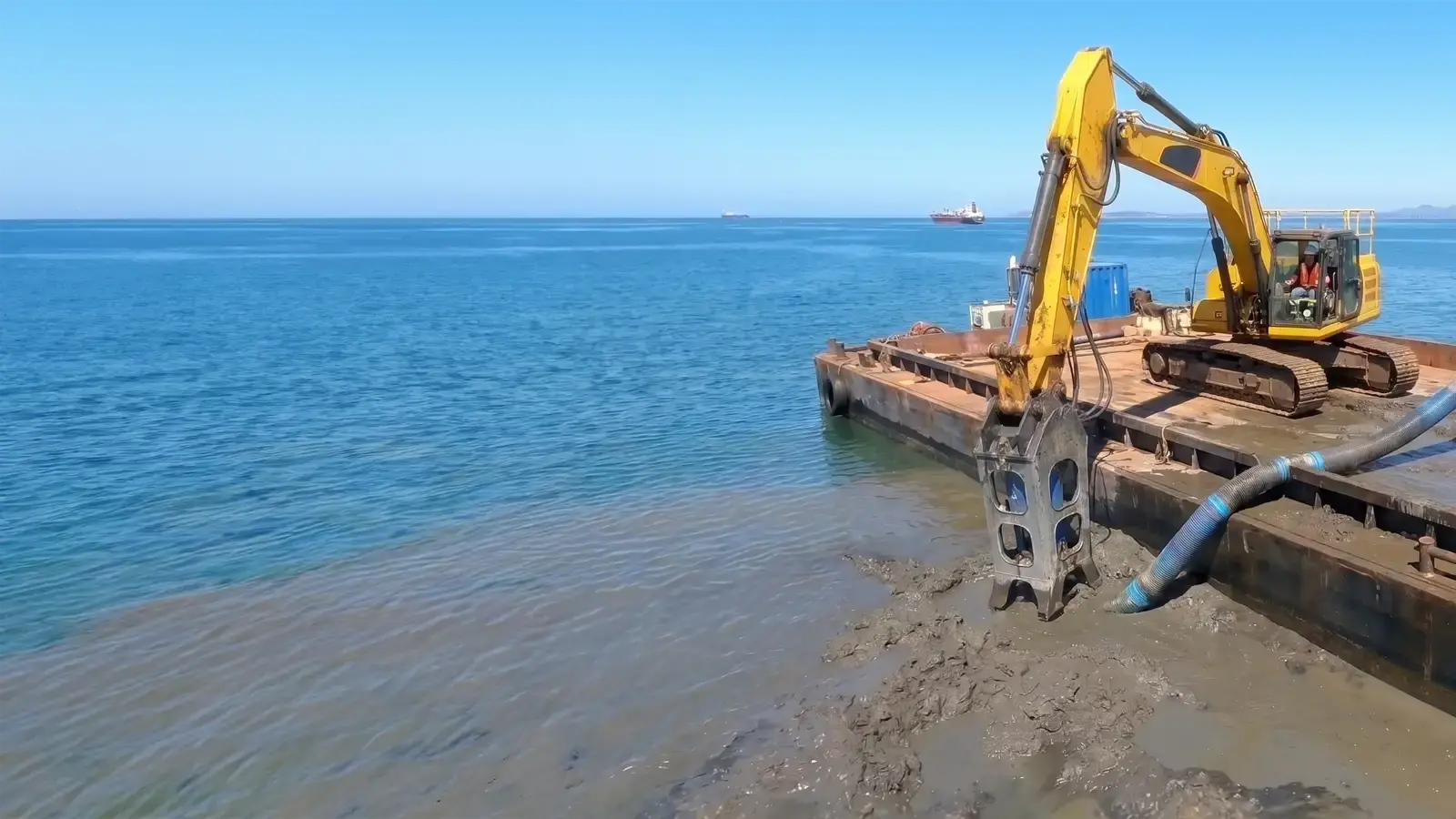
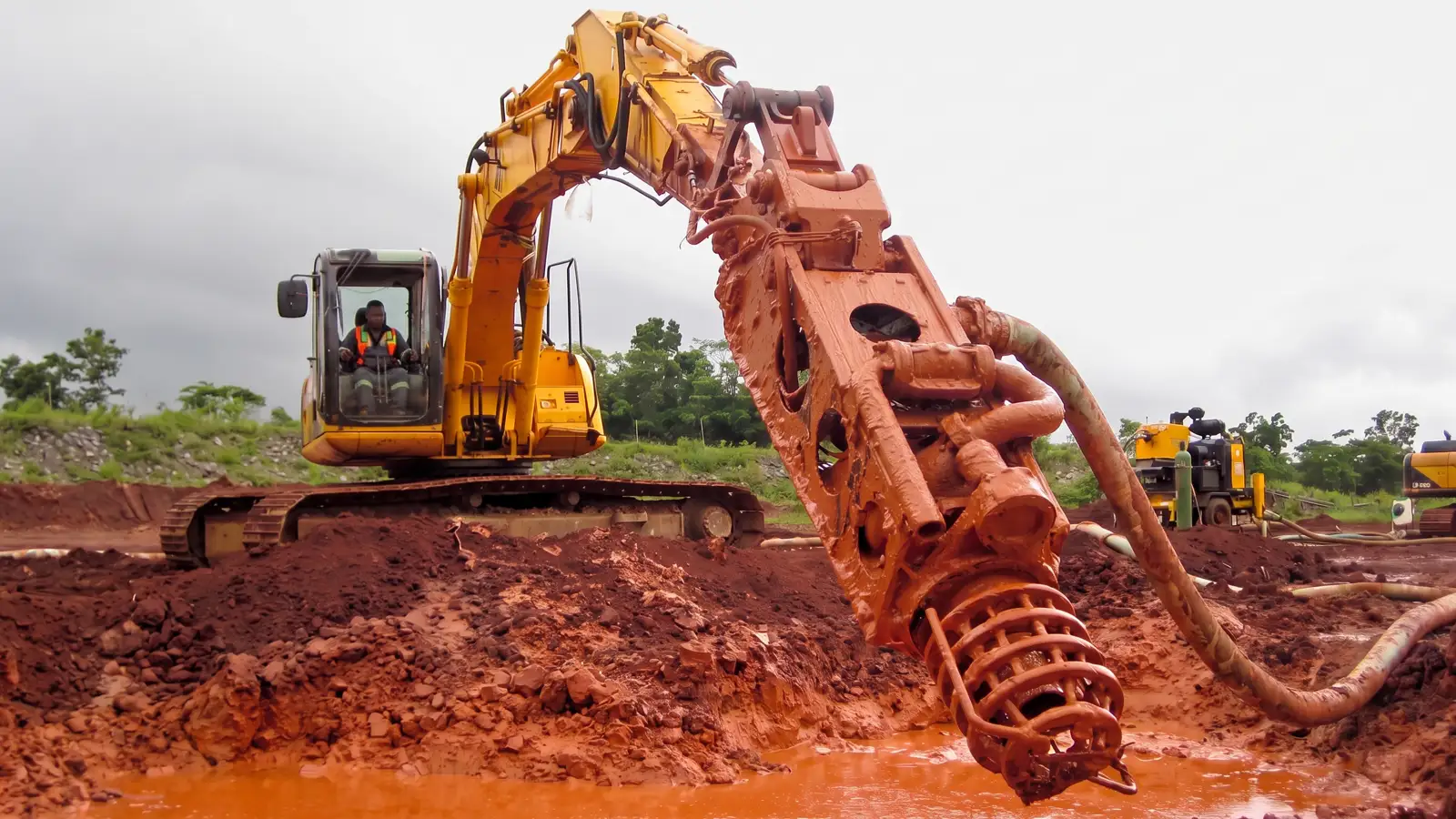
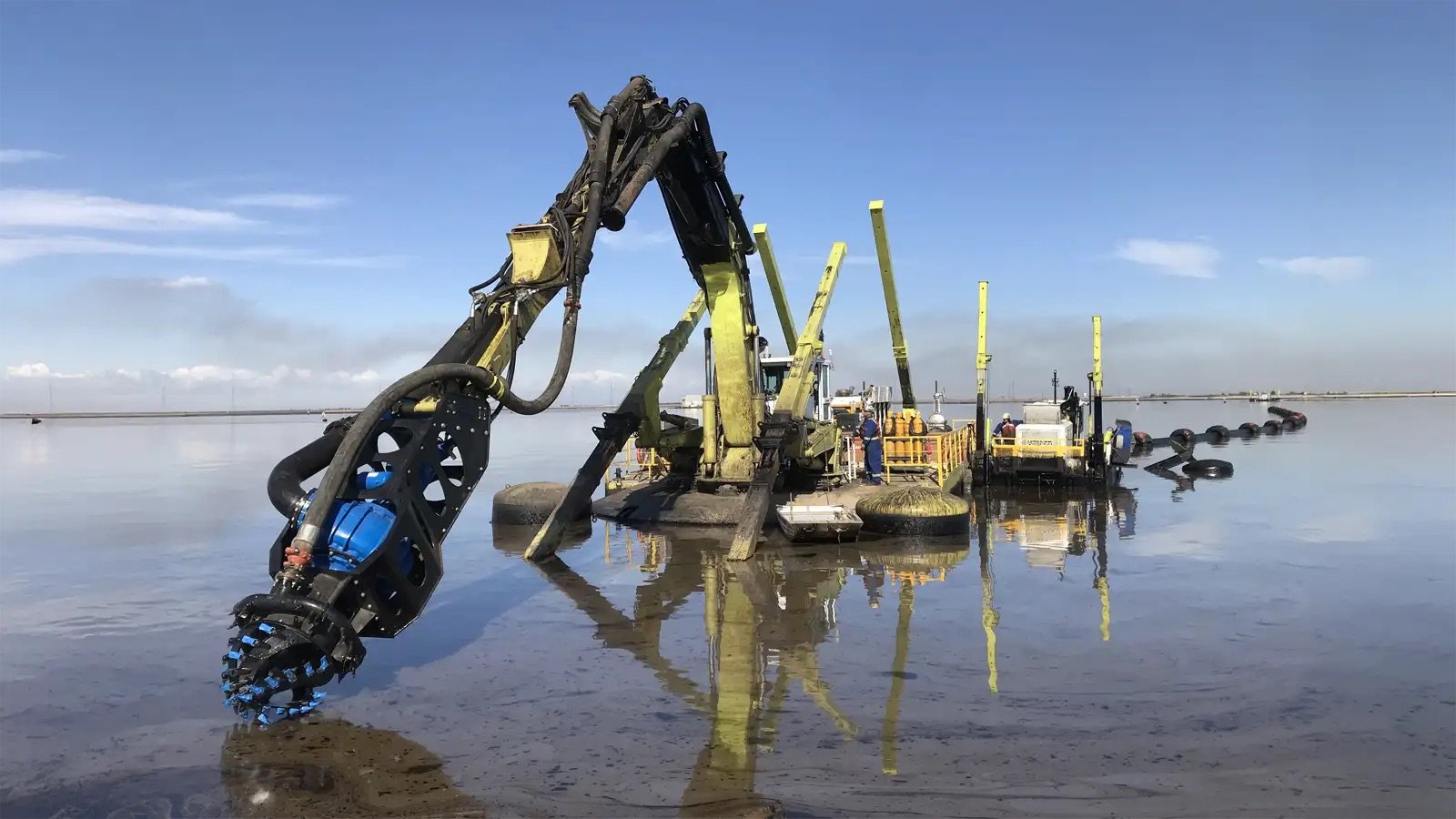
An excavator-mounted slurry pump replaces the bucket or mounts to the excavator linkage and places the pump directly at the dredging face. The excavator positions the attachment while a cutterhead, auger, water-jetting ring, or other agitation system loosens the material and feeds it into the pump.
EDDY Pump offers multiple cutterhead and agitation options because sand, compacted clay, sticky sludge, mine tailings, and lined ponds do not respond to the same material-feeding method. The attachment can run from excavator auxiliary hydraulics or, when needed, a standalone hydraulic power unit.
Putting the pump at the material source reduces the need for a long suction line and allows the operator to reposition the pump as conditions change. That mobility is one of the biggest reasons excavator attachments work well in ponds, lagoons, canals, tailings areas, industrial basins, and sites where a conventional dredge is difficult to launch.
Step 1: Confirm the Excavator’s Hydraulic Capacity
Do not size the pump from excavator tonnage alone. Carrier weight matters for stability and attachment handling, but the pump motor is driven by hydraulic power. The key numbers are the auxiliary hydraulic flow in GPM and pressure in PSI available at the boom end under working conditions.
Hydraulic flow primarily affects motor speed and pump RPM. Hydraulic pressure provides the torque needed to keep the pump and cutterhead working under load. Both must be available at the same time. A machine that can reach the required pressure but not the required flow is not a match, and neither is a machine that has flow but cannot maintain pressure in dense material.
Model-specific hydraulic requirements may include separate pump and cutterhead circuits, required line sizes, protection valves, and hose routing to the boom end. Confirm the available auxiliary circuit with the excavator manufacturer or dealer, and verify actual output with a hydraulic flow test when the machine history or settings are uncertain.
What to confirm before selecting the attachment:
- Continuous auxiliary flow available at the required pressure—not only the maximum published value.
- Whether the pump and cutterhead need separate hydraulic circuits.
- Hydraulic line diameter, routing, couplers, and allowable return backpressure.
- Cooling capacity and expected hydraulic oil temperature during continuous operation.
- Carrier weight, reach, lift capacity, stability, and attachment mounting requirements.
- Whether an external hydraulic power unit is a better fit than excavator power for the project.
Step 2: Define Flow and Production Separately
Flow rate and production rate are related, but they are not the same number. Flow rate is the total slurry volume moving through the discharge line. Production rate is the amount of solid material removed over time.
The same pump flow can produce very different cubic yards per hour depending on slurry density, solids concentration, material behavior, and operating time. A project moving dense sand at a high solids concentration may remove more solids per gallon than a project pumping dilute silt—but it may also require more hydraulic power and experience more wear.
Set a realistic production goal and separate theoretical pump capacity from expected jobsite production. Repositioning, material variability, hose handling, debris, inspection, and maintenance all affect actual output. Do not build the project schedule around 100% utilization.
Step 3: Calculate Total Dynamic Head Correctly
Total dynamic head (TDH) is the resistance the pump must overcome at the target flow. It includes static elevation, friction loss through hose or pipe, and losses through bends, valves, fittings, and transitions.
One important correction for submerged excavator pumps: the pump’s depth below the water surface is not automatically added to static head. In an open system, static head is generally the elevation difference between the source liquid level and the discharge point. The surrounding water pressure at the submerged pump offsets the depth below the surface. The exact calculation changes when tanks are pressurized or other system conditions apply.
Pipeline friction is often the bigger variable. Losses increase with flow, pipeline length, bends, fittings, slurry density, viscosity, particle interaction, and internal roughness. A clean-water friction chart is only a starting point. Use slurry-specific corrections and compare the resulting system requirement with the project-specific pump curve.
For a deeper explanation, see How Far Can You Pump Slurry? and use EDDY Pump’s custom pump curve review to evaluate the operating point for the actual material and pipeline.
Step 4: Characterize the Slurry, Not Just the Water
The pump is not moving water with a few solids in it. It is moving a material system. That means the slurry data has to be specific enough to predict how it will behave in the pump and pipeline.
- Material type: sand, silt, clay, sludge, gravel, tailings, ash, organics, or a mixture.
- Solids concentration: clearly identify whether the value is by weight or by volume.
- Slurry density or specific gravity.
- Maximum particle size and particle shape—not only the average size.
- Viscosity, yield behavior, or tendency to become sticky or thixotropic.
- Presence of fibrous material, trash, timber, metal, or other irregular debris.
- Abrasiveness, corrosivity, pH, and temperature.
- Settling behavior and the minimum transport velocity needed to keep solids moving.
A large solids passage helps reduce clogging risk, but particle shape still matters. A pump that can pass a round rock of a given diameter may not respond the same way to a long piece of timber, cable, fabric, or fibrous debris.
Step 5: Size the Discharge Hose and Pipeline With the Pump
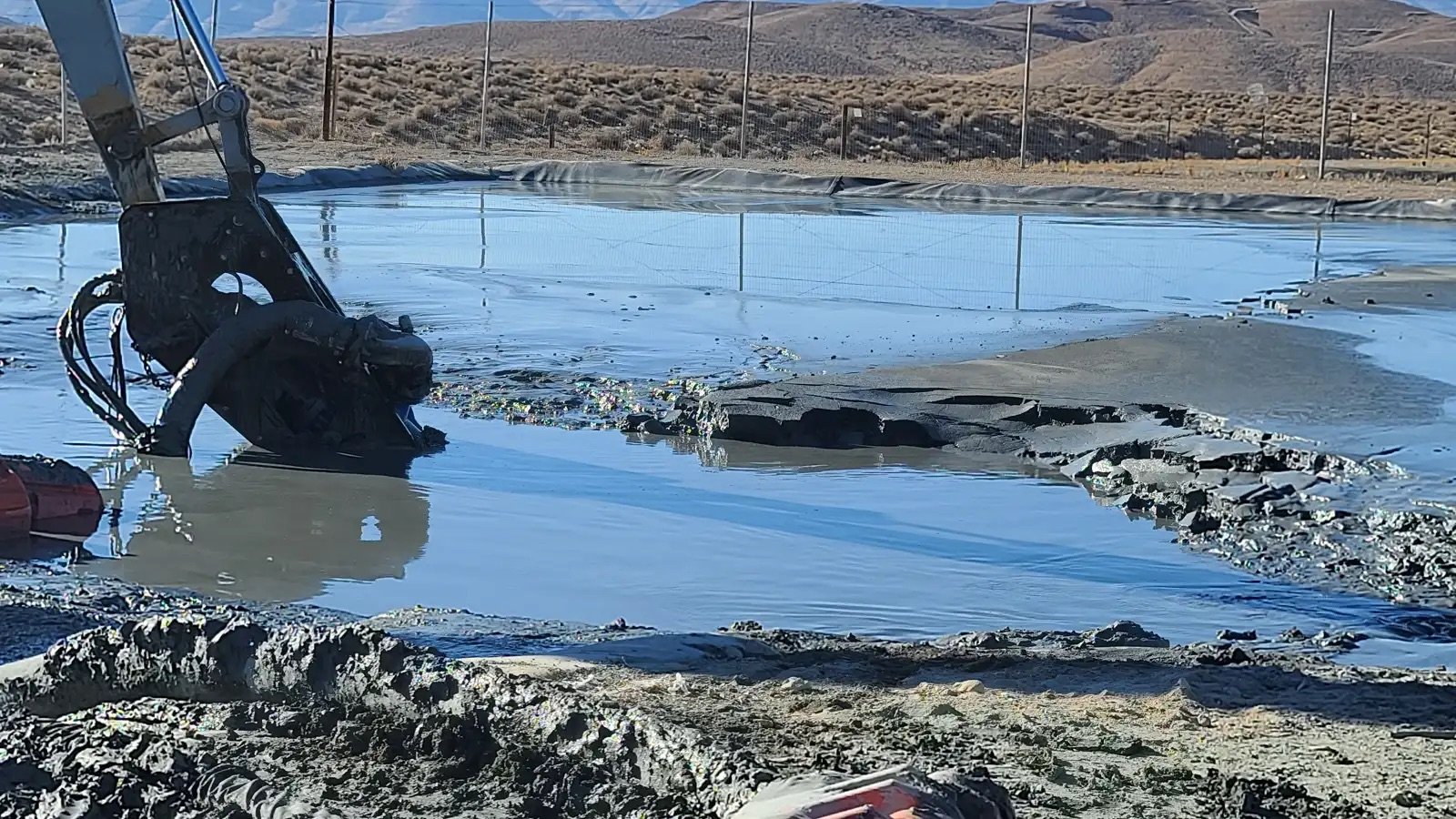
The pump and pipeline have to be sized together. A hose that is too small increases velocity, friction loss, pressure, and wear. A line that is too large can reduce velocity enough for solids to settle.
Review the full route from the pump discharge to the final placement area. Include flexible hose, floating hose, HDPE pipe, elevation changes, bends, manifolds, dewatering equipment, and the final outlet condition. Longer pipelines may require a different pump model, a larger line, a lower production target, or a booster pump rather than simply choosing the largest excavator attachment.
Pipeline details to provide:
- Total hose and pipe length.
- Inside diameter and material of each section.
- Vertical elevation from the source liquid level to the discharge point.
- Number and type of bends, valves, reducers, and fittings.
- Whether the line is floating, surface-laid, buried, or supported on structures.
- Expected discharge pressure and any downstream process restrictions.
- Whether the route or discharge point will change during the project.
Step 6: Review Submergence and Suction Conditions
A standard excavator dredge pump attachment normally operates submerged at the dredging face. That keeps the intake close to the material and avoids the long suction lift that creates priming and cavitation problems in remote surface-pump setups.
Submergence still matters. Insufficient water depth, vortexing, air entrainment, blocked intake flow, high temperature, dissolved gas, or dense slurry can reduce suction performance. The attachment should be positioned so material can enter the pump consistently without starving the intake or drawing excessive air.
Self-priming is a separate configuration. EDDY Pump also offers a Self-Priming Excavator Pump & Bucket for projects that benefit from a self-priming pump arrangement. Do not assume every excavator attachment has the same priming or run-dry capability; verify the selected system.
Excavator Pump Attachment Sizing Checklist
|
Information Needed |
What to Provide |
|
Excavator hydraulics |
Available auxiliary GPM and PSI, number of circuits, line size, cooling, carrier model and weight |
|
Material |
Type, density, solids percentage and basis, particle-size distribution, maximum debris, viscosity, pH and temperature |
|
Production target |
Desired cubic yards per hour or tons per hour and realistic operating hours |
|
Flow requirement |
Target slurry GPM or process throughput requirement |
|
Static elevation |
Source liquid level compared with final discharge elevation |
|
Pipeline |
Length, inside diameter, hose/pipe material, bends, fittings, valves and discharge condition |
|
Site conditions |
Water depth, excavator access, reach, bank stability, liner restrictions and relocation needs |
|
Maintenance plan |
Expected abrasiveness, inspection access, lifting needs, spare parts and service support |
EDDY Pump Excavator Attachment Model Range
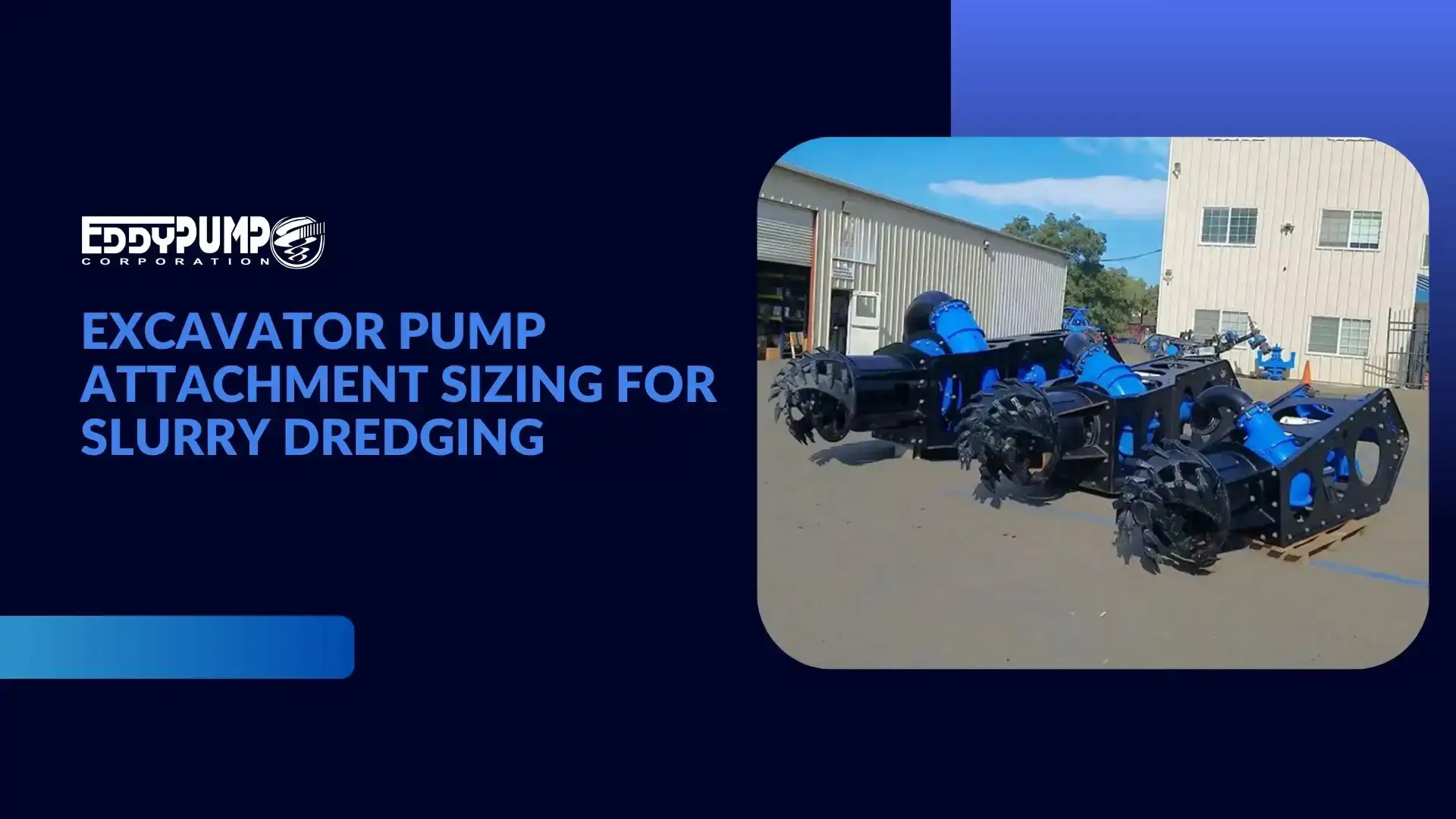
EDDY Pump’s hydraulic excavator attachment family is available in 4-inch through 12-inch discharge sizes. The table below shows the current published family ranges. These are capability ranges—not guaranteed project output. Actual performance depends on the material, hydraulic drive, pump speed, TDH, and pipeline.
|
Model / Carrier |
Flow (GPM) |
Head |
Max Solids |
Solids by Weight |
Production |
|
4-in discharge | 20–45 tons |
250–1,200 |
Up to 160 ft |
Up to 3 in |
40–70% |
75–150 yd³/hr |
|
6-in discharge | 20–45 tons |
450–2,500 |
Up to 200 ft |
Up to 5 in |
40–70% |
150–200 yd³/hr |
|
8-in discharge | 60–94 tons |
1,400–3,600 |
Up to 230 ft |
Up to 7 in |
40–70% |
250–300 yd³/hr |
|
10-in discharge | 60–94 tons |
1,600–5,000 |
Up to 240 ft |
Up to 9 in |
40–70% |
300–350 yd³/hr |
|
12-in discharge | 60–94 tons |
2,600–7,300 |
Up to 180 ft |
Up to 11 in |
40–70% |
500–600 yd³/hr |
Before choosing a model, review the current excavator attachment brochures and specification sheets and confirm the hydraulic circuit, carrier compatibility, mounting, hose routing, and pump curve with EDDY Pump engineering.
How to Think About 4-Inch, 6-Inch, 8-Inch, 10-Inch, and 12-Inch Attachments
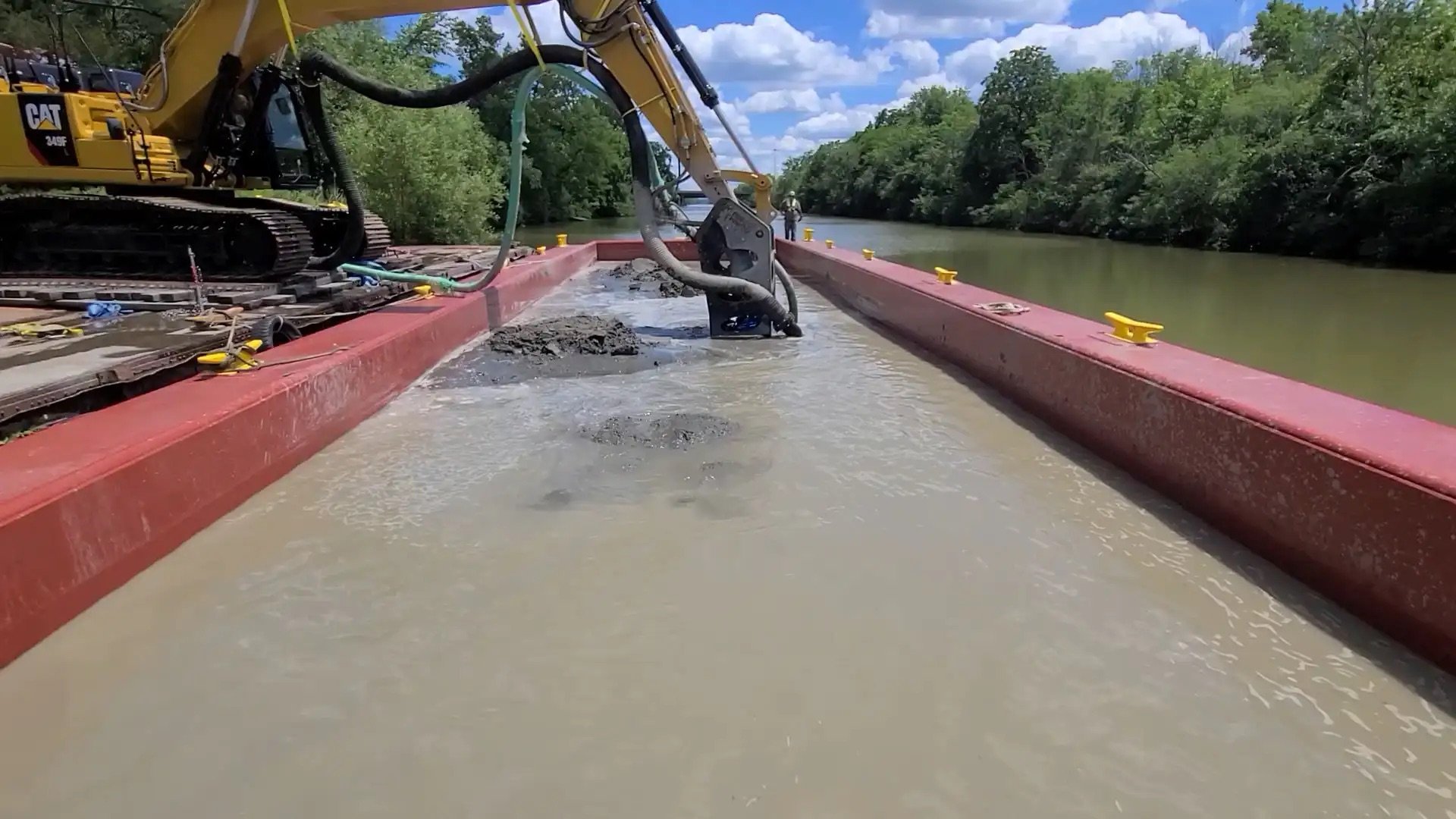
It is tempting to match pump size to a simple application label: a small pump for a pond, a larger pump for a harbor, and the largest pump for mining. Real projects are not that clean.
A confined pond with a long uphill discharge can require more head than a large open basin with a short line. A tailings project may need a large solids passage but a moderate flow. A high-production sand job may need a larger model, but only if the carrier and hydraulic system can support it.
Use the model range as a starting point, then answer these questions:
- Can the excavator supply the pump and cutterhead hydraulic requirements continuously?
- Does the pump curve meet the target flow at the calculated slurry TDH?
- Can the pump pass the largest expected solids and tolerate the material abrasiveness?
- Will the discharge line maintain transport velocity without excessive friction and wear?
- Does the predicted production rate support the schedule after realistic downtime and repositioning?
When an Excavator Attachment Is the Right Tool—and When It Is Not
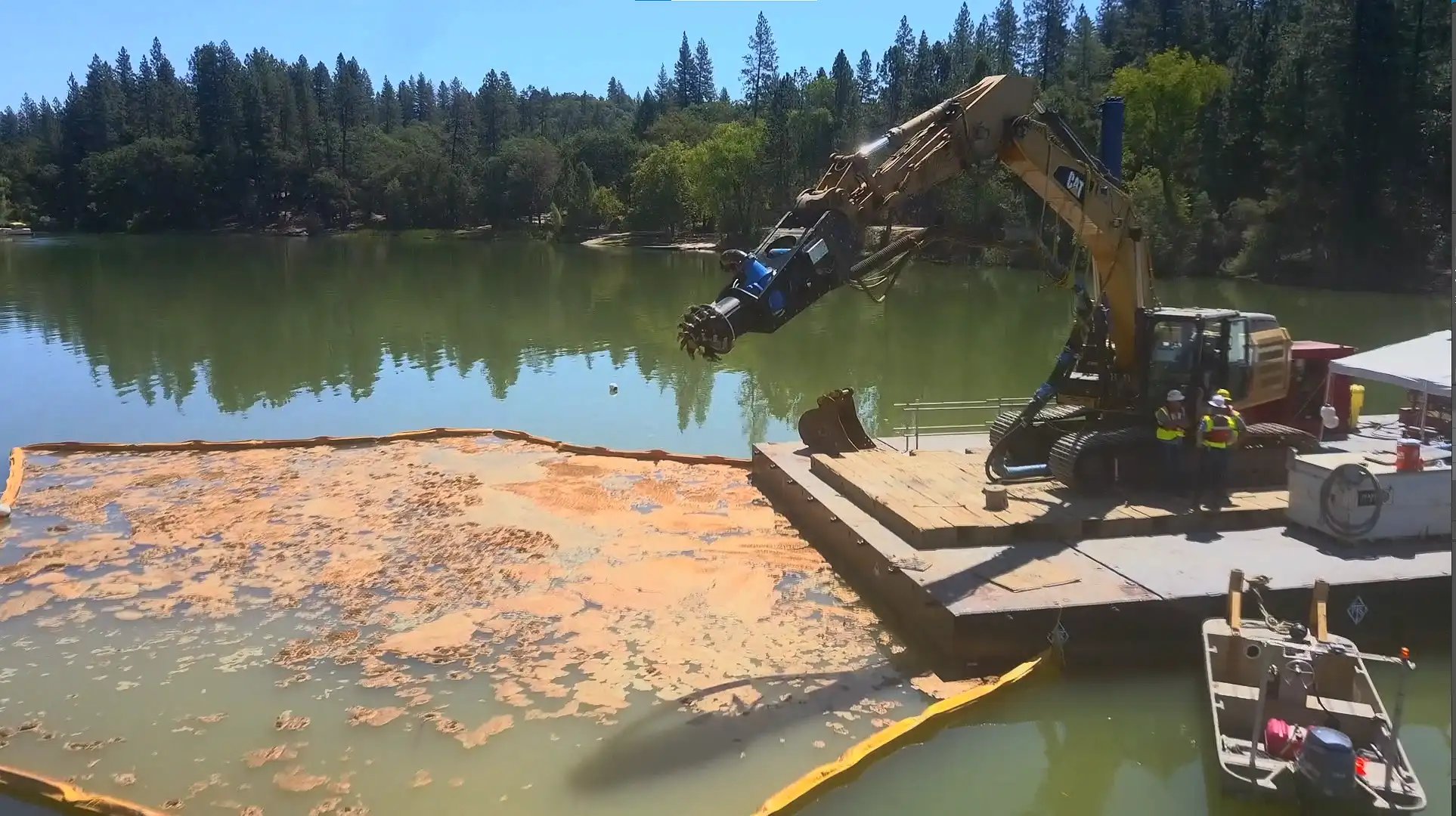
Excavator pump attachments are a strong fit when:
- The excavator can reach the dredging face from shore, a road, a bench, a barge, or an amphibious undercarriage.
- The project requires frequent repositioning or precise material removal.
- A conventional floating dredge is difficult to launch or mobilize.
- The work involves ponds, lagoons, canals, basins, tailings, sludge, sand, or industrial cleanup.
- The operator needs to cut, agitate, and pump material with one excavator-mounted system.
A different configuration may be better when:
- The project is a large, continuous, deep-water dredging campaign that favors a dedicated dredge platform.
- The pipeline requires booster stations or a system layout that is not practical from one excavator attachment.
- The pump must operate from a fixed location while separate equipment feeds material to it.
- Site geometry, reach, carrier stability, or access prevents the excavator from working safely at the dredging face.
For those projects, compare the attachment with custom dredging systems, trailer-mounted pumps, cable-deployed dredges, or other EDDY Pump configurations before committing to the equipment plan.
How EDDY Pump Addresses the Sizing Variables
EDDY Pump’s excavator attachments are designed around a recessed open rotor and large internal clearances for abrasive, viscous, and high-solids material. The purpose is straightforward: keep material moving while reducing the narrow passages that commonly create clogging and wear problems in conventional pumps.
The attachment family combines that pump design with application-specific agitation options, excavator or HPU drive choices, and accessories such as hose carriers, flow meters, pressure gauges, and liner-safe dredging configurations.
Those capabilities do not remove the need for sizing. They make the attachment adaptable. The engineering work still determines which model, hydraulic package, cutterhead, hose size, and pipeline arrangement fit the job.
Frequently Asked Questions About Excavator Pump Attachment Sizing
How do I determine what size excavator pump attachment I need?
Start with the excavator’s available auxiliary hydraulic flow and pressure. Then define the target production rate, characterize the slurry, calculate total dynamic head, and map the discharge pipeline. Select the model only after the hydraulic requirements and project-specific pump curve match those conditions.
Can any excavator run a slurry pump attachment?
No. The excavator must have the required carrier capacity, auxiliary hydraulic flow and pressure, circuit configuration, cooling capacity, line routing, and mounting interface. An external HPU may be used when excavator hydraulics are not the best match.
What is the most important sizing number: GPM, head, or solids capacity?
None of them works alone. Flow and head determine the operating point, while solids concentration, particle size, density, and viscosity change power demand, friction loss, wear, and production. The attachment must meet all of them as a system.
Does pump depth below the water surface count as static head?
Not automatically. For a submerged pump in an open basin, static head is generally based on the elevation difference between the source liquid level and the discharge point. Pump depth affects submergence and suction conditions, but it is not simply added to static lift.
How far can an excavator dredge pump move slurry?
Distance depends on flow, hose or pipe diameter, elevation, bends, slurry properties, pump curve, and allowable pressure. There is no single distance rating. Calculate slurry TDH and determine whether the project needs a larger line, a different operating point, or a booster pump.
What solids concentration can EDDY Pump excavator attachments handle?
The current hydraulic attachment family is published for approximately 40–70% solids by weight, depending on the model and application. Actual performance must be reviewed against slurry density, viscosity, particle size, hydraulic power, and the discharge system.
What is the difference between an excavator attachment and a self-priming excavator pump bucket?
The standard EXF attachment operates at the dredging face as a submerged hydraulic pump. The Self-Priming Excavator Pump & Bucket is a separate configuration that combines an excavator-mounted digging and agitation tool with a self-priming pump arrangement. Verify which configuration fits the site and operating method.
Do I need a booster pump for a long discharge line?
A booster may be appropriate when the required TDH would push the primary attachment outside its intended operating range. A system calculation should determine whether a booster, larger pipe, lower flow target, or different pump configuration is the better solution.
What information should I send EDDY Pump for a sizing review?
Provide the excavator model and auxiliary hydraulic data, material description, solids percentage and basis, particle size, density, viscosity if known, target production, water depth, discharge elevation, hose or pipe diameter, pipeline length, fittings, and the final discharge condition.
Talk to EDDY Pump Before You Commit to a Model
Excavator pump attachment sizing is not a discharge-size decision. It is a system decision. The carrier, hydraulic power, slurry, pump curve, hose, elevation, and production target all have to agree.
Share your project details through the custom pump curve and quote form or contact EDDY Pump’s sales and engineering team for a model and system review before finalizing the equipment package.