
How do you prevent cavitation in an industrial pump? The practical answer is to make sure the pump always has more suction energy available than it needs. That suction margin is called net positive suction head, or NPSH. When pressure at the pump inlet drops too low, the liquid can flash into vapor bubbles that collapse violently inside the pump. That collapse is cavitation, and it can damage the rotor or impeller, wear surfaces, seals, bearings, and pump casing.

For clean water systems, cavitation is already expensive. For slurry pumps, it can be worse because cavitation damage and abrasive wear work together. Dense slurry, sediment, tailings, sludge, grit, and other solids-laden fluids already place the pump under heavy duty. If the suction side is starved, the pump is forced to fight both vapor collapse and abrasive material at the same time.
This guide explains NPSH in plain English, compares NPSHa and NPSHr, shows the field conditions that create cavitation, and outlines the EDDY Pump configuration path: flooded suction pumps, submersible slurry pumps, self-priming pumps, and booster pumps.
|
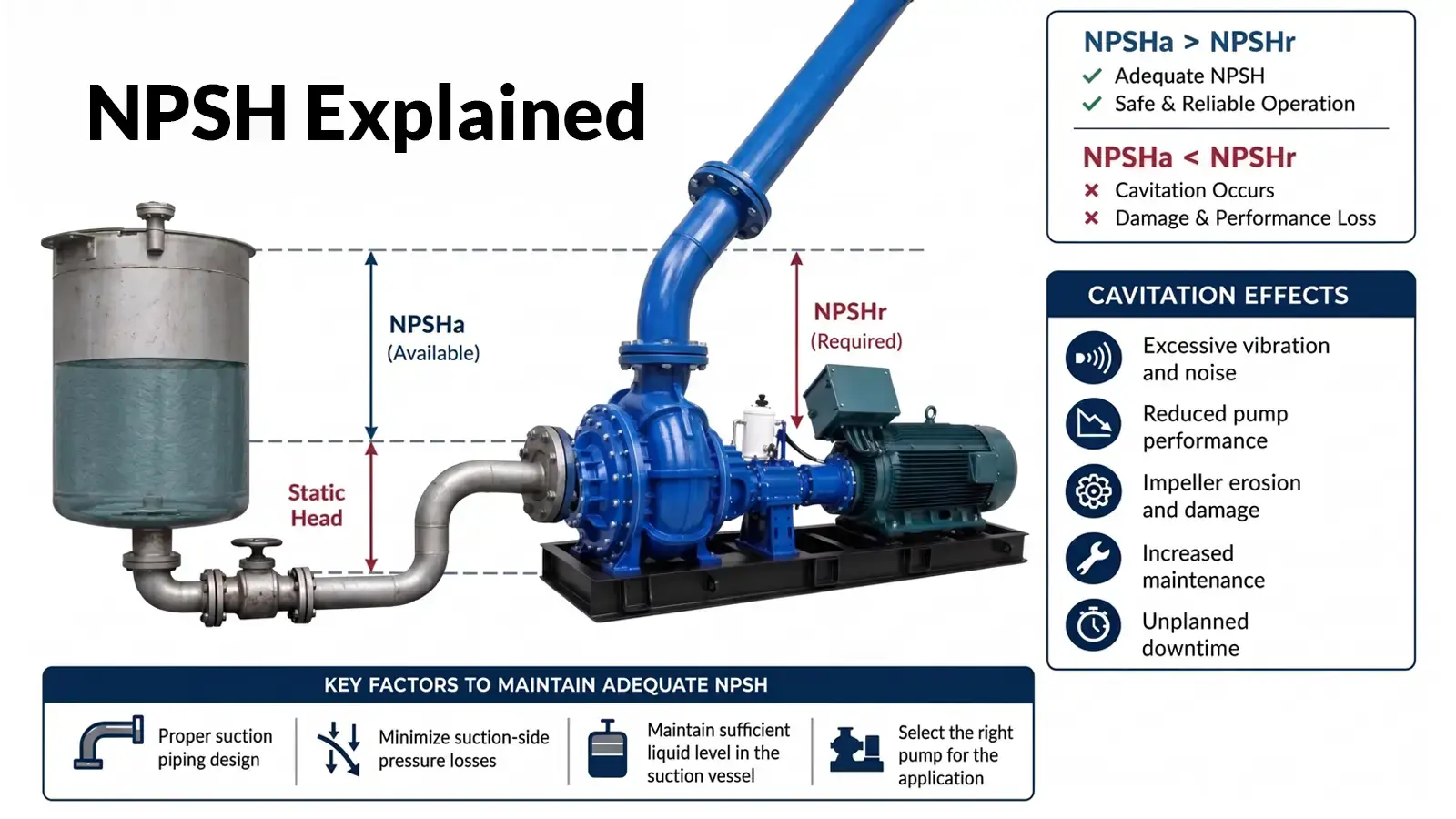
Quick answer To prevent cavitation, keep NPSHa safely above NPSHr at the actual duty point. NPSHa is what the site supplies at the pump suction. NPSHr is what the pump requires at a given flow and speed. Cavitation risk increases when NPSHa drops, NPSHr rises, or the pump is forced to operate away from the selected point on the curve. The most common fixes are to lower the pump, use a flooded suction or submersible configuration, shorten and enlarge the suction line, reduce suction restrictions, keep strainers clean, avoid overspeeding, select the pump around the real system curve, and add booster support when suction or pipeline conditions require it. For slurry applications, the margin should be confirmed against the actual material, not assumed from clean-water conditions. |
Key Takeaways
- NPSH is the suction energy available at the pump inlet above the liquid's vapor pressure. If that margin gets too low, cavitation can occur.
- NPSHa comes from the system: liquid level, suction pressure, elevation, temperature, and suction-line friction. NPSHr comes from the pump curve at a specific flow and speed.
- Cavitation prevention is not just a pump issue. It requires the right installation, suction piping, pump speed, operating point, and pump configuration.
- Flooded suction and submersible configurations usually provide more forgiving suction conditions than suction-lift layouts because they reduce or eliminate suction lift.
- In high-solids slurry service, the safest path is to send the real slurry, flow, head, pipe, distance, temperature, and elevation data to engineering for a custom pump curve and system review.
Why NPSH Matters More in Slurry and Industrial Pumping
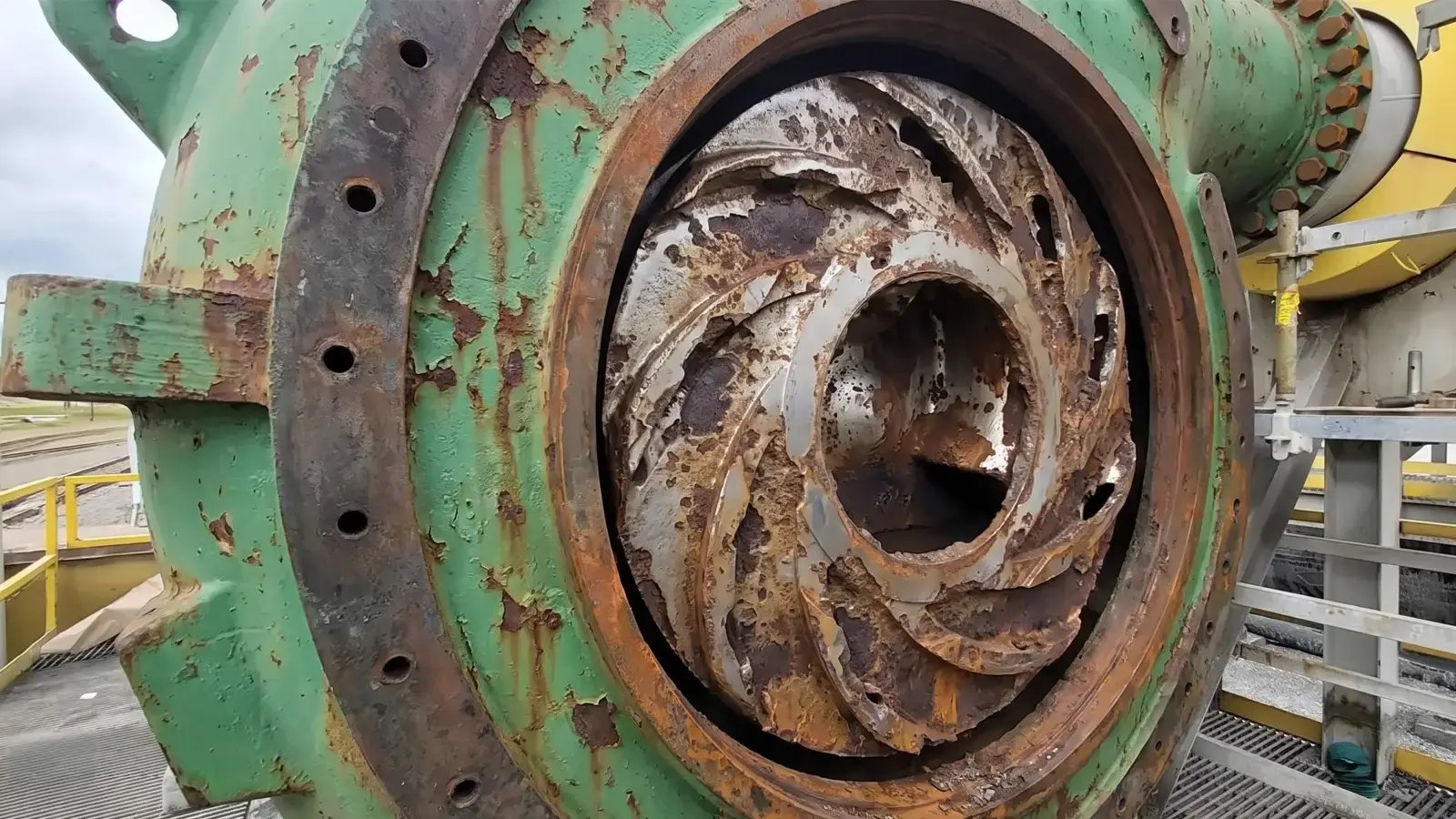
Cavitation is a pressure problem, but the consequences show up as reliability, production, and maintenance problems. Operators usually notice a rattling or gravel-like sound, vibration, unstable flow, lower discharge pressure, seal issues, or faster wear. By the time the pump is noisy, cavitation may already be damaging wetted components.
In slurry service, cavitation rarely happens alone. Abrasive material is already moving through the pump. When vapor bubbles collapse, they pit surfaces and weaken the areas that abrasive solids then continue to erode. That means a suction-side problem can quickly become a wear-parts problem, a seal problem, and a production problem.
What NPSH Means in Plain English
Net positive suction head is the pressure energy available to move liquid into the pump before that liquid starts to boil at the inlet. The word 'boil' does not mean the fluid has to be hot like boiling water in a pot. It means local pressure has dropped low enough that vapor bubbles form. When those vapor bubbles move into higher-pressure areas inside the pump, they collapse. That collapse is cavitation.
NPSHa vs. NPSHr
The easiest way to understand NPSH is to separate the system from the pump.
|
Term |
What it means |
Controlled by |
What improves it |
|
NPSHa |
Net Positive Suction Head Available: the suction energy your system supplies at the pump inlet. |
Liquid level, static pressure, elevation, temperature, suction piping, valves, strainers, and friction losses. |
Flooded suction, shorter/larger suction line, cleaner inlet, lower temperature, lower pump elevation, better suction conditions. |
|
NPSHr |
Net Positive Suction Head Required: the suction energy the pump needs at a specific flow and speed. |
Pump design, pump speed, rotor/impeller geometry, flow rate, and operating point on the curve. |
Correct pump selection, lower speed where possible, larger suction/pump size when needed, and operation closer to the intended duty point. |
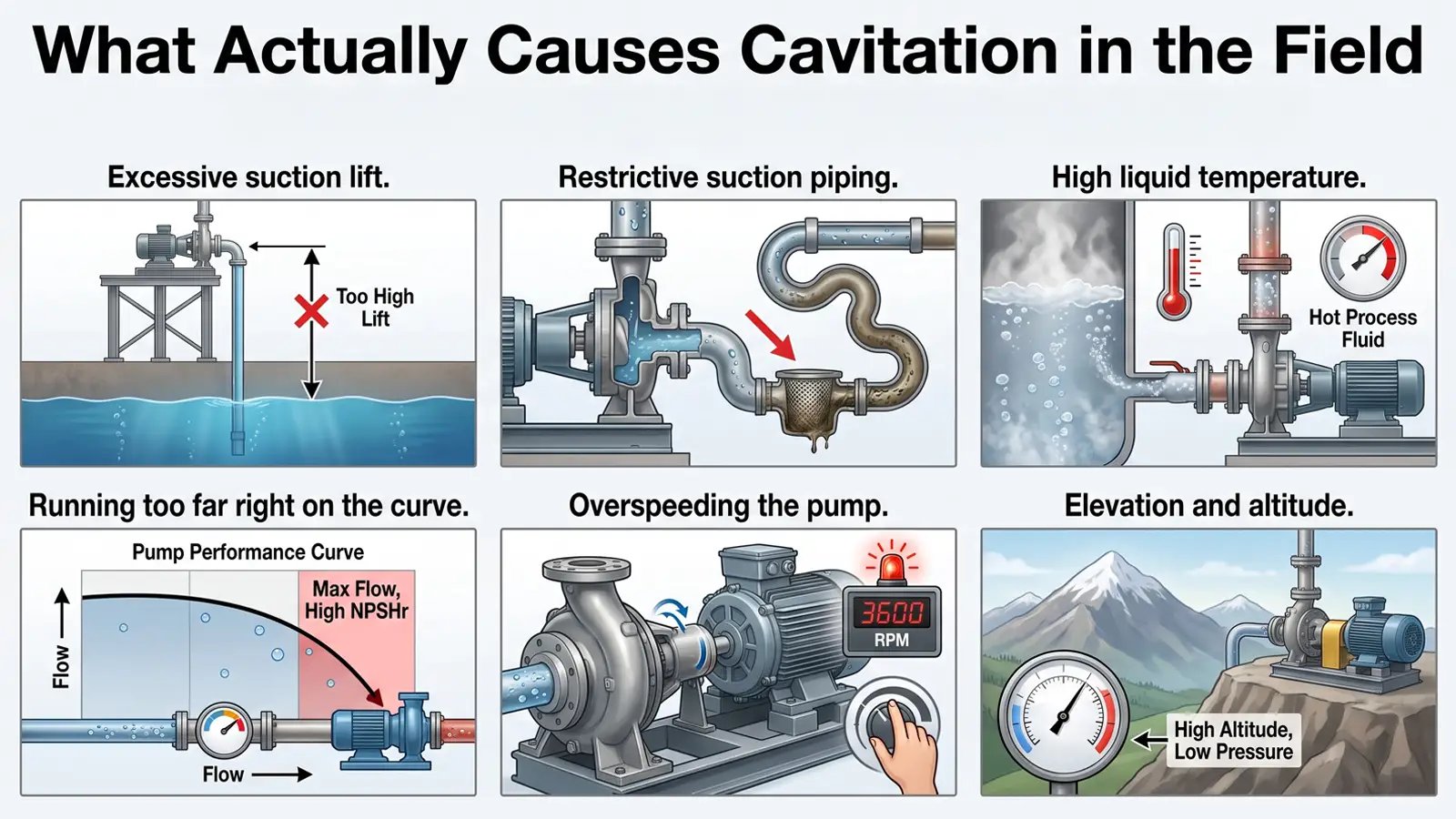
What Causes Cavitation in the Field?
Most cavitation problems trace back to the suction side of the system or to a pump being operated outside the conditions it was selected for.
- Too much suction lift: every foot the pump must lift liquid reduces the available suction head.
- Long or undersized suction piping: friction losses rise quickly when the suction line is too small, too long, or full of bends.
- Blocked strainers or suction screens: debris, settled solids, and partial blockage reduce inlet pressure.
- High liquid temperature: hotter liquid has higher vapor pressure, which reduces the NPSH margin.
- Operating too far right on the pump curve: chasing more flow can raise the pump's NPSHr and increase cavitation risk.
- Overspeeding: increasing pump speed can raise NPSHr and push the system into an unstable condition.
- Altitude or low source pressure: lower atmospheric pressure reduces the pressure available at the suction source.
- Air leaks or poor suction hose condition: air entering the suction line interrupts liquid continuity and can mimic or worsen cavitation symptoms.
Symptoms That Point to Cavitation
|
Symptom |
What it may mean |
What to check first |
|
Rattling or gravel-like sound |
Vapor bubbles may be forming and collapsing inside the pump. |
Suction lift, blocked strainer, suction valve position, liquid level, and NPSH margin. |
|
Vibration |
Unstable inlet conditions or vapor collapse may be loading the rotating assembly. |
Suction piping, inlet restrictions, bearing condition, and operating point. |
|
Loss of flow or pressure |
The pump may be starved at the inlet or operating off the selected curve. |
Flow, discharge pressure, pump speed, slurry density, and suction restrictions. |
|
Seal or bearing failures |
Cavitation shock and vibration may be shortening component life. |
Seal leakage, bearing temperature, alignment, lubrication, and suction stability. |
|
Rapid wear or pitting |
Cavitation erosion may be compounding abrasive slurry wear. |
Rotor/impeller surfaces, casing/volute, wear parts, and material compatibility. |
How to Prevent Cavitation: Practical Checklist
- Position the pump lower when possible. Moving the pump closer to or below the liquid level is one of the most effective ways to improve NPSHa.
- Use flooded suction when the process layout allows it. A constant gravity-fed inlet keeps the pump primed and reduces the suction-lift burden.
- Consider submersible pumping for pits, sumps, and wet wells. A submerged pump removes the suction-lift problem because the pump operates directly in the material.
- Shorten and enlarge the suction line. Keep suction piping as short, straight, and large as practical to reduce friction losses.
- Clean strainers and avoid suction throttling. Restrictions on the suction side reduce inlet pressure and should be treated as a cavitation risk.
- Control pump speed. Run the pump at the lowest speed that meets the duty point, instead of overspeeding to chase flow.
- Use the right pump curve. Confirm the selected pump at the real flow, TDH, slurry density, pipe size, discharge distance, temperature, and elevation.
- Add booster support when distance or system pressure requires it. Booster pumps can help maintain pressure and support long-distance slurry transfer when the main pump cannot carry the entire system alone.
Suction Lift vs. Flooded Suction vs. Submersible
The configuration matters because each option changes the suction side of the system.
|
Configuration |
Pump location |
NPSH impact |
Best-fit use |
Main trade-off |
|
Flooded suction |
Pump sits below or at the liquid source so gravity feeds the inlet. |
Usually stronger NPSHa and lower cavitation risk. |
Fixed plants, tanks, hoppers, process systems, continuous slurry duty. |
Requires a layout where the source can stay above the pump. |
|
Submersible |
Pump operates directly in the pit, pond, sump, or wet well. |
Eliminates suction lift because the pump is submerged. |
Dewatering, pits, sumps, dredging, wastewater, tailings, and wet installations. |
Requires submerged service access and proper power/hydraulic setup. |
|
Self-priming / suction lift |
Pump stays on the surface and draws material through a suction line. |
More sensitive to lift, hose length, air leaks, and inlet restrictions. |
Remote sites, portable setups, surface installations, tank/sump cleanout. |
More flexible placement, but tighter suction margin. |
|
Booster-supported |
One or more booster pumps support pressure along the system. |
Helps maintain system pressure and protect production over distance. |
Long discharge distances, high TDH, dredging, mining, pipeline transfer. |
Requires pump spacing and curve review. |
Where Pump Selection Fits the Customer Journey
Many buyers search for NPSH because something is already going wrong: a pump is noisy, losing flow, wearing out quickly, or failing to prime. The next step is not just to define NPSH. The next step is to connect the symptom to the correct pump configuration.
|
Customer situation |
Likely issue |
EDDY path to consider |
Engineering data needed |
|
Pump is above the liquid and struggles to prime |
Suction lift, air leaks, or excessive inlet friction. |
Self-priming pump review, lower pump position, or flooded suction if layout allows. |
Lift height, suction hose length/diameter, material, temperature, and duty point. |
|
Fixed process system has a tank or hopper above the pump |
Best opportunity to eliminate suction lift. |
Flooded suction pump configuration. |
Tank outlet elevation, pipe size, flow/head, slurry density, solids size, and duty cycle. |
|
Pump is in a pit, sump, or wet well |
Surface suction may be unnecessary and unstable. |
Submersible slurry pump configuration. |
Submergence, pit depth, power availability, solids, flow/head, discharge distance. |
|
Pump works at short distance but struggles over long pipeline runs |
TDH and friction losses may exceed the main pump's stable range. |
Booster pump system and custom curve review. |
Pipeline length, elevation profile, slurry density, pipe size, target flow, and booster location. |
|
Pump cavitates only after speed increase |
NPSHr rises with speed and flow. |
Recheck curve, speed, power package, and system curve. |
RPM, current operating point, target flow, VFD/hydraulic settings, and slurry data. |
How EDDY Pump Approaches NPSH and Cavitation
EDDY Pump builds high-solids slurry pumps around a patented recessed rotor and open internal flow path. That design helps move dense slurry, abrasive material, and larger solids through the pump without the tight internal passages that often cause clogging and wear problems in conventional pumping systems.
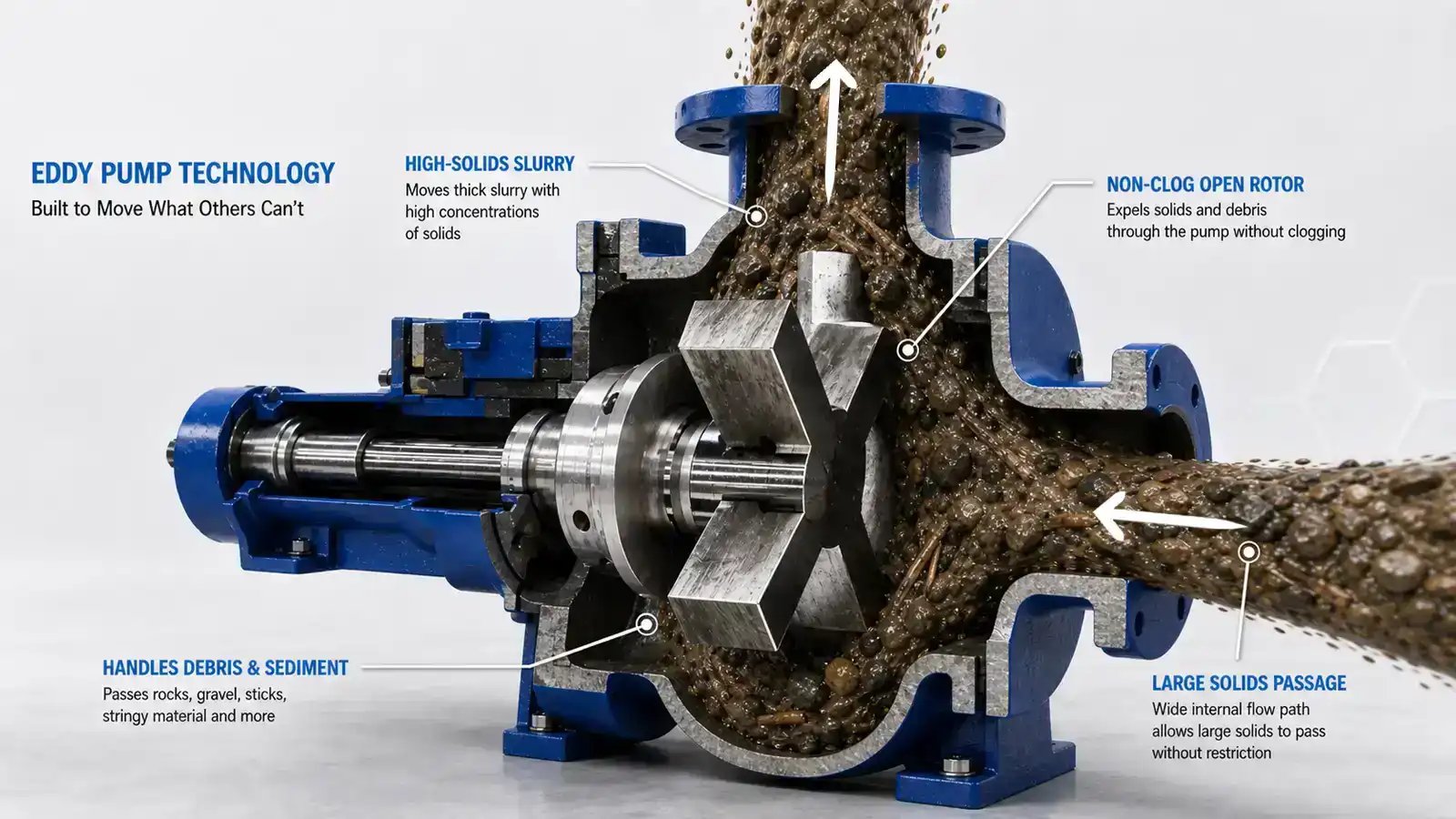
For NPSH and cavitation prevention, the bigger advantage is configuration flexibility. The same pump platform can often be engineered as a flooded suction pump, submersible pump, self-priming pump, hydraulic or electric package, dredging system, or booster-supported system. That lets the application team solve the suction condition instead of forcing every site into the same pump layout.
The responsible recommendation is not that any pump is immune to cavitation. Cavitation is a system condition. If the available suction head is too low for the selected duty point, the system still needs to be corrected. EDDY Pump's role is to help match the pump platform, power package, suction configuration, and custom pump curve to the real slurry and installation.
What to Send EDDY Pump Engineering
For NPSH and cavitation questions, the quote path should ask for the information that determines the actual operating point.
- Fluid or slurry type, including percent solids by weight, specific gravity, viscosity, temperature, and particle size.
- Required flow rate and production target.
- Total dynamic head, discharge distance, pipe or hose diameter, fittings, bends, and elevation changes.
- Suction source: open pit, tank, hopper, pond, sump, barge, process vessel, or suction hose.
- Pump position relative to liquid level, including suction lift or flooded inlet height.
- Power source and speed control: electric, diesel, hydraulic/HPU, VFD, or other drive package.
- Current pump symptoms: noise, vibration, flow loss, seal failure, priming issues, wear patterns, or cavitation damage.
Frequently Asked Questions
What is NPSH in simple terms?
NPSH, or net positive suction head, is the suction energy available at the pump inlet above the point where the liquid would start to vaporize. Enough NPSH keeps the liquid liquid as it enters the pump, which helps prevent cavitation.
What is the difference between NPSHa and NPSHr?
NPSHa is the NPSH available from the system. It depends on the suction source, elevation, liquid level, temperature, vapor pressure, suction piping, valves, strainers, and friction losses. NPSHr is the NPSH required by the pump at a specific flow and speed. Cavitation prevention means keeping NPSHa above NPSHr with the right project-specific margin.
What causes pump cavitation?
Cavitation happens when the pressure at the pump inlet drops low enough that vapor bubbles form and then collapse inside the pump. Common causes include too much suction lift, restrictive suction piping, clogged strainers, high liquid temperature, air leaks, overspeeding, and operating too far out on the pump curve.
How do I stop an industrial pump from cavitating?
Improve the suction side first. Lower the pump, use a flooded suction or submersible configuration when possible, shorten and enlarge the suction line, clean strainers, remove suction restrictions, avoid overspeeding, and confirm the pump against the real system curve. For long-distance slurry transfer, a booster pump may be needed.
Why is cavitation worse in slurry pumps?
The physics are the same as clean-water cavitation, but slurry service adds abrasive wear. Vapor-bubble collapse can pit surfaces, and abrasive solids then continue eroding those damaged areas. That can shorten wear-part life, reduce efficiency, and create unplanned downtime.
Is flooded suction better for cavitation prevention?
Flooded suction is often more forgiving because gravity feeds the pump inlet and reduces or eliminates suction lift. It is not automatically the right layout for every site, but when a fixed installation can keep the pump below the liquid source, it usually provides a stronger NPSH margin.
Can a self-priming pump cavitate?
Yes. A self-priming pump can still cavitate if suction lift is too high, the suction hose is too long or undersized, the inlet is restricted, the pump is oversped, or the system does not provide enough NPSHa for the selected duty point.
Can a booster pump fix cavitation?
A booster pump can help when the system needs more pressure support, especially on long pipelines or demanding discharge distances. The booster must be selected from the system curve so it supports the main pump without creating a new operating problem.
How much NPSH margin should I use?
There is no single margin that fits every slurry application. The required margin depends on the pump, fluid, temperature, altitude, speed, duty point, and criticality of the service. For abrasive or high-solids slurry, confirm the margin with pump engineering rather than relying on a generic rule of thumb.
What data does EDDY Pump need for an NPSH or cavitation review?
Send the material type, percent solids by weight, temperature, flow rate, TDH, suction lift or flooded inlet height, pipe size, discharge distance, elevation profile, power package, and current symptoms. That information allows engineering to review the pump curve and recommend the right configuration.
Build the Suction Side Into the Pump Selection
Cavitation is predictable, and in most cases it is preventable. The key is to treat suction conditions as part of pump selection, not as an installation detail to fix later. For industrial slurry systems, that means reviewing NPSHa, NPSHr, pump speed, piping, liquid level, slurry density, solids size, temperature, and discharge distance before the pump is finalized.
EDDY Pump's applications engineering team can review your real duty point and recommend the right pump platform, configuration, and suction-side approach. Request a custom pump curve or submit your project details to confirm the correct setup before cavitation becomes a maintenance problem.